
Stardew Valley, on its surface, is a very simple game. You come across a deed to your grandfather’s farm, and decide to move out of the city and away from your crappy office job to start your life anew. You grow crops that change with the seasons, sell them for money, raise livestock, and live out your dream of relaxing in the rural country side. However, underneath this super simple premise lies a deep, rich, and complex story, with different intertwining threads that make up the collective personality and community of Stardew Valley.
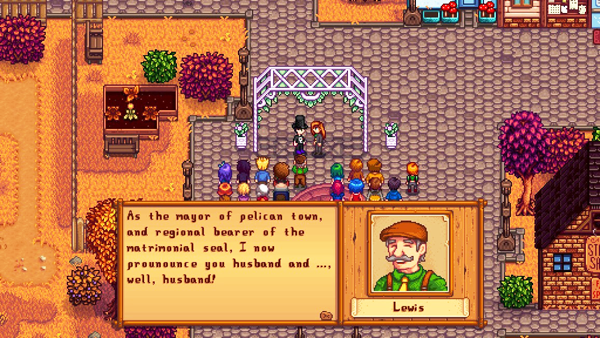
It’s also a place where things like bigotry and horrible viewpoints contained in our real world just don’t exist – the most offensive thing that can happen in this game is an older grandpa telling you he doesn’t like how you loiter around the town, or if you accidentally gift your neighbor a piece of trash, and that’s about it. It’s a place where you can change your appearance at the drop of a hat, and express yourself however you please. Most importantly, it’s a place where you can fall in love with whoever you choose, no matter what gender you select at the start of the game. This game allows you to be unapologetically you, and it doesn’t care about who you are, what you identify as, or where you’re from.
As someone who is openly queer, representation is a huge battle the LGBT+ community fights for everyday. We strive to just be seen as normal people, not some tragic love interest that gets killed off for the sake of plot, or an oversaturated perception of outdated stereotypes. Whenever it’s made public that a new movie or TV show will have a queer character make an appearance, ignorant people see it as shoving a “homosexual agenda” in their faces, when in reality we’ve been force fed horrible heteronormative plot lines for much, much longer. In video games, it’s sadly not very different. Even in the world of farming games like Harvest Moon, one of the main inspirations for Stardew Valley, you could only marry male characters if you played as a female, and vice versa. You couldn’t even customize your character; you were just stuck with whatever cutesy model that was assigned to you.
This brings us back to Stardew Valley. Stardew Valley is a game that doesn’t “force” you into any particular camp when it comes to who you love. You organically build a relationship with all the different characters over your time living in their community. You learn about their likes and dislikes, their hobbies and interests, and even their goals and aspirations outside of this tiny rural town. You start to learn each character’s unique daily routine that changes with the seasons, and you can even do favors for them and bring them certain crops or other items they may need. Stardew Valley is simply a game about exploring at your leisure, taking the time to enjoy every second of everyday, and get to know everyone at your own pace.
This is exactly why Stardew Valley is a huge step in the right direction for queer representation: with the friendly environment and the fact you can take everything at your own pace, it’s easier to feel safe to express yourself how you want to be truly seen, and to love who you want to without fear of judgement. LGBT+ people’s lives are constantly put in danger simply by the act of being their true selves, with significantly higher rates of being bullied, discriminated against or abused, and along with that the rate of suicides in LGBT+ youth are up to three times higher than that of their straight peers. The world is not safe for LGBT+ people by any means, even with the fact we’ve made significant progress within the last 10-20 years.
This is why I love Stardew Valley so much. It can provide a safe environment for those who feel pressured to hide away their true selves from society and those they’re close to. It’s a get away from the horrible world queer people have to face on a day to day basis. It’s a place where they can be safe, and most importantly, it’s a place where they can love and be loved, unconditionally.
To be honest, I could go on for hours about the other types of amazing representation in this game, especially outside LGBT+ characters. There’s Kent, a war veteran father who you don’t meet until you’ve gone through your first year of farming, who struggles with PTSD and trying to adjust back to civilian life with a loving wife and two sons. There’s Shane, a struggling depressed alcoholic trying to get by in his day to day life, who loves to take care of rare blue chickens and his goddaughter, Jas. There’s Alex, the classic jock football player who dreams of playing in a professional league, and also lives with his grandparents since both of his own parents tragically passed away a few years before. There’s Haley, a know-it-all popular girl with a secret love for photography, and a deep love for her great grandmother, who she has a bracelet from that she keeps on her at all times. The character development in this game is outstanding, and this barely even scratches the surface of what incredible stories hide beneath this game’s easy-going surface.
So I guess, in summary, Stardew Valley isn’t just an important game for LGBT+ youth. It’s a game for people in all walks of life, with all types of issues, to come together and feel safe and happy, and feel valid with adequate and accurate representation.
And really, who could ask for more than that.
 Digi-Dive!